
Dental Implants
An implant replaces both the root and the crown, giving a missing tooth back its full bite force instead of just filling the gap.

- An implant is a titanium post placed in the jawbone that fuses with bone over time, a process called osseointegration.
- Treatment follows four stages: consultation and imaging, implant placement, abutment, and the final crown.
- Implants restore full chewing force in a way that dentures or bridges resting on the gum do not.
- With proper care, implants can have a potential lifetime lifespan.
Am I a candidate for dental implants?
Patients missing one or more teeth with adequate jawbone density and healthy gums are generally candidates for implants. Dr. Rohit Khurana, whose postgraduate training included oral implantology specifically, evaluates jawbone volume through imaging at your consultation to confirm implants are the right fit before proceeding.
What happens during dental implants at Sauga Smiles Dental?
Consultation and imaging
X-rays or 3D imaging assess your jawbone and plan the exact placement of the implant.
Implant placement
The titanium post is placed into the jawbone, where it will fuse with the bone over the following months through osseointegration.
Abutment
Once the implant has integrated with the bone, a connector piece called an abutment is attached to hold the future crown.
Final crown
A custom crown, matched to your natural teeth, is attached to the abutment to complete the restoration.
What should I expect afterward?
Mild swelling and soreness at the implant site are normal for the first few days, managed with basic pain relief. Full osseointegration, the implant fusing with the jawbone, takes a period of months, after which the abutment and crown stages proceed.
Does insurance or CDCP cover dental implants?
Sauga Smiles Dental does not publish a fixed price list for this treatment, since the right plan depends on what a doctor sees at your exam. The clinic is a CDCP-approved provider, bills most major insurance plans directly, and offers 0% financing for patients who qualify. Call 905-277-1560 and the front desk will work out your personal cost before you commit to anything.
Implants are the closest thing we have to giving a patient their tooth back, root and all. The oral implantology training in my master's degree was specifically about doing this properly, from reading the bone on imaging through the final crown.
Dr. Rohit Khurana, BDS, MDS (Periodontology & Oral Implantology)
Common questions about dental implants
Dental implants have a potential lifetime lifespan with proper care, including regular cleanings and good oral hygiene, though this varies by individual case.
Possibly, though jawbone density can decrease over time in an area where a tooth has been missing for a long while. Dr. Rohit Khurana will assess your bone volume through imaging at a consultation to confirm whether an implant can be placed directly or whether additional steps are needed first.
Osseointegration is the process by which the titanium implant post fuses directly with your jawbone over a period of months, creating the stable foundation that makes an implant function like a natural tooth root.
Implants replace both the root and crown of a missing tooth and restore closer to full bite force, whereas bridges and removable dentures rely on neighboring teeth or the gum for support. Which option is right depends on your jawbone, overall health, and how many teeth are missing, which is worth discussing directly with the dentist.
Related services
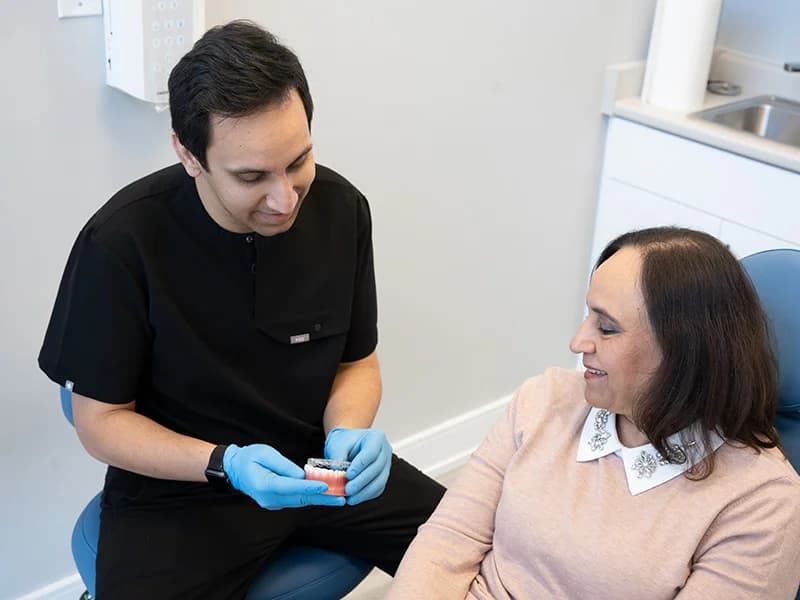


Ready to talk about dental implants?
Call 905-277-1560 or book online. Sauga Smiles Dental is open seven days a week at 800 Burnhamthorpe Rd W Unit #1, Mississauga.