Dentures
Full and partial dentures are built to fit your bite, not a generic mold, which is the difference between dentures that work and ones that just sit there.
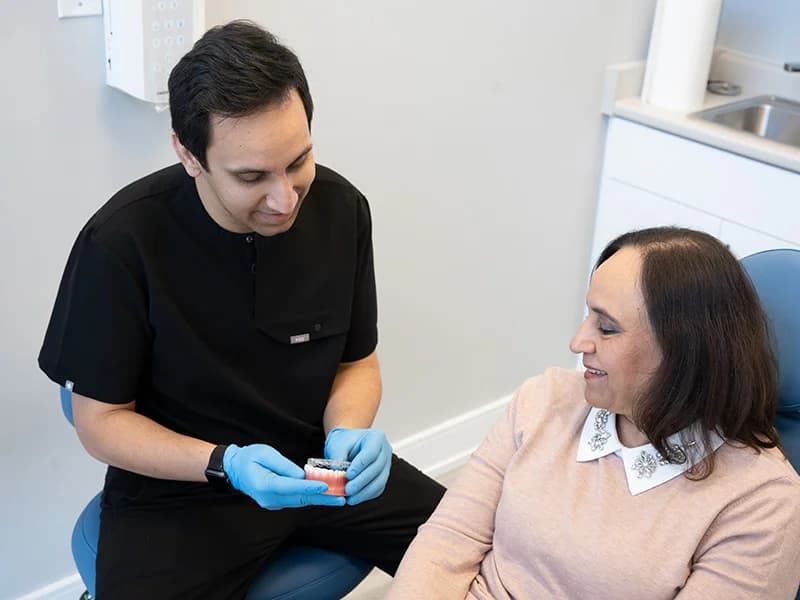
- Full dentures replace an entire arch of teeth; partial dentures fill gaps around remaining natural teeth.
- Implant-supported dentures anchor to titanium implants for a more secure fit than removable dentures alone.
- Partial dentures use metal or acrylic clasps to hold onto your natural teeth.
- New dentures should be rinsed after eating, brushed with a denture brush and mild soap, and soaked overnight.
Am I a candidate for dentures?
Patients missing all their teeth in an arch are candidates for full dentures. Patients with some remaining healthy teeth are usually better suited to a partial denture, which clasps onto those teeth rather than replacing them unnecessarily. Patients who want a more stable fit and have adequate jawbone may be candidates for implant-supported dentures instead of, or in addition to, a removable option.
What happens during dentures at Sauga Smiles Dental?
Consultation and impressions
The dentist examines your gums and any remaining teeth, then takes impressions to begin building a denture shaped to your mouth.
Fitting and adjustment
The denture is tried in and adjusted for bite and comfort before it is finalized, since a denture that does not sit right causes sore spots.
Delivery
You leave with the finished denture and specific guidance on wearing it in gradually, since most new denture wearers need a short adjustment period.
Follow-up adjustments
Gums and jawbone shift slightly over the following weeks, so a follow-up visit lets the dentist fine-tune the fit.
What should I expect afterward?
Most new denture wearers need one to a few weeks to adjust to speaking and eating comfortably. Soft foods at first and rinsing with warm salt water help if there is minor gum irritation while you adjust.
Does insurance or CDCP cover dentures?
Sauga Smiles Dental does not publish a fixed price list for this treatment, since the right plan depends on what a doctor sees at your exam. The clinic is a CDCP-approved provider, bills most major insurance plans directly, and offers 0% financing for patients who qualify. Call 905-277-1560 and the front desk will work out your personal cost before you commit to anything.
A denture built off a generic mold might technically fit in the mouth, but it won't function well when you're actually eating or talking. We take the extra time on impressions and the follow-up adjustment because that's what makes the difference.
Dr. Rohit Khurana, BDS, MDS (Periodontology & Oral Implantology)
Common questions about dentures
A full denture replaces every tooth in an upper or lower arch. A partial denture fills the gaps left by missing teeth while clasping onto your remaining natural teeth, which is why it is only used when some healthy teeth remain.
Rinse dentures after eating to remove food particles, brush them daily with a denture brush and mild soap rather than regular toothpaste, which can be abrasive, and soak them overnight in water or a denture solution so they do not dry out.
Implant-supported dentures anchor to titanium implants placed in the jawbone, which generally gives a more secure, stable fit than a removable denture resting on the gums alone. Whether it is the right option depends on your jawbone and overall health, which Dr. Rohit Khurana can assess during a consultation.
Most patients need anywhere from a few days to several weeks to adjust to speaking and chewing normally with new dentures. Starting with softer foods and practicing reading aloud can speed up the adjustment.
Related services



Ready to talk about dentures?
Call 905-277-1560 or book online. Sauga Smiles Dental is open seven days a week at 800 Burnhamthorpe Rd W Unit #1, Mississauga.